Wednesday, 27 August 2014

"Seconds" by Bryan Lee O'Malley

Aaaaaaaaaaaah blog blog blog I missed you so much! I haven't written anything in you for months and I'm sorry. It may seem like I left you for that cute new Tumblr thing but I barely post anything there either. Truth be told, I've gone from working on a really heavy, tiring job (see it here and here) that took up all my weekends and energy for a good couple of months, to taking time off all paid work to immerse myself in a personal project for the first time since uni. It will be seen eventually, and it isn't going to be anything grand but I know the exercise will have been productive.

Today, however, I am taking a break from that project to write in here. I recently picked up and read Bryan Lee O'Malley's Seconds, a one-off graphic novel which is his newest work after Scott Pilgrim. I'd never actually read the latter (only having seen the movie, always a shameful thing to admit to for me), but Joe Sparrow specifically recommended Seconds to me, and the man knows me very well so I had to pick it up.


This isn't going to be a "review". Such things have their place, but many will have written reviews about this book (I haven't read any of them), and it's not my intention to write a brief summary and a watered down opinion for the benefit of people who might be considering picking the thing up. I'll be writing about some specific reactions I had to it, and will assume throughout that the reader has also read the book. Thus, spoilers will be everywhere.


On the whole I really enjoyed it. In particular the story tapped very potently into thoughts I've had for years about regrets and mistakes and owning your decisions. O'Malley's art is good, too.


However, there were two major aspects of the story that felt misjudged somehow. They were Max, and the other house spirit (or witch, or shadow, or mirror, as it is variously referred to).

When I first read through it felt wrong to me that Katie ends up back together with Max at the end. At first I wrote this off to my own emotional baggage around breakups leading me to feel that once you've broken up with somebody it's clear that it was never meant to be and you just have to move on no matter what. However, as I thought about it more and reread the book, I now feel certain that aspects of how Max's character are portrayed aren't quite right.

In order for it to feel thematically correct for Katie and Max to be together at the end, we as the audience need to believe that he is truly valuable, important, and healthy in her life. However, I never felt like the story was convincing me of this. The first time we see Max he frankly comes off as a smarmy shit. He gives Katie his sparkly smile and she melts. We are shown that Katie is infatuated with him, informing us that we're supposed to like him too. However, nothing in this first encounter makes me, at least, like him at all. The story seems to be suggesting that even Katie's feelings for him are entirely superficial, as her reaction is all passion, hormones, irrational emotion, not an honest response to him doing positive things for her as a person. In fact, their whole interaction seems wrong to me given the backstory. It doesn't look like two people who were in a relationship for four years (by which time most couples have moved from the "passion" stage to the "commitment" or "companionate" stage) and then broke up, but who still sincerely love eachother months later. It looks like a girl talking to her high-school crush. However, we're supposed to buy into this vague, nebulous, unconvincing magnetism Max has for Katie. And her feelings are so apparently shallow that she blows him off immediately.

One could say that this first encounter is maybe too brief to establish anything more than this. For Katie's part it's maybe not unreasonable: her avoidant nature (the key aspect of her personality as far as the story is concerned!) is coming out and she's pushing him away. However, I don't feel that this is an excuse from a storytelling point of view. Max ends up being central to the plot, arguably the chief external influence in Katie's descent into her mistake-ridden mess, so the first scene in which we see him, in which his entire relationship to the protagonist is set up, and in which all our expectations and perceptions of him are established, deserves more than these insubstantial four pages.

Subsequent sightings do little to improve my perceptions of Max. The second time around is more of the same: smarmy smile, gets cut short, again with a plot excuse. The third time we actually get to see the backstory. This is the point at which, even if we allow the brevity of the previous encounters, we can expect to really see what Max is like as a person. However, that still doesn't happen. We get to know that he was, in fact, a smarmy cock, and that he and Katie conversed easily before boinking. And somewhere in there a four-year relationsip hahppened. But we're told this, not shown. I finally get the goods on what went down between them, and I still don't love him as much as she does. For crying out loud, the most prominent part of this story is when Katie says "I guess what we had wasn't that strong". The first honest-sounding thing she's said about or to him so far.

And then Katie figures out that she can fix their relationship with the magic mushrooms. This is where things start to feel really off. She's seen him twice so far in the novel, and both times she blew him off within a minute (the second time was during a revision, but it still counts). Hell, both times he was actually trying to talk things over maturely and she still petulantly pushed him away. So suddenly being expected to believe that she still loves him enough to immediately get back into bed with him is a bit much.

(By the way, compare all this to Katie's relationship with Hazel, which we see develop organically and which provides Katie with important emotional outlet and feedback, and the one time we see signs of it breaking down, when Katie neglects the friendship for just a couple of days and finds their conversation suddenly awkward, it comes off as far more poignant and well-observed than umpteen iterations of "I need him to love me")

Now, up to this point I've been commenting retroactively. I'm calling aspects of Max and Katie's interaction "off" or "wrong" based on my knowledge of what comes later (that their relationship is fulfilling). However, in the vacuum of reading the story for the first time, there is actually nothing fundamentally wrong, at least from a storytelling point of view. Because it seems like Bryan Lee O'Malley is setting something up. And as Katie makes more revisions, and things start to spiral out of control, and in particular when she changes things relating to Max, this seems to be reinforced. She finds herself lying next to him in bed, they're still together, living together, and even married. She finds herself stunned at having his stuff in her room, and indulges herself by huffing his clothes in the wardrobe (a physical, hormonal response). However, many things are wrong. Though having boy things in her room is exciting, she is visibly unsettled by the compromise of her personal space, even as she denies it to the narration. Even less progress has been made on Lucknow, her new restaurant, than in the original timelines. Max is running the proceedings on it, not her. The servers at Seconds all love him and not her. She has compromised important aspects of her life for her obsession with Max.

And as she makes more revisions things only get worse. Based on his suggestion, she revises the decision to set up the new restaurant at Lucknow, and instead goes with Talmadge. And having retroactively ceded more control to Max, she finds him invading her life further. It is no longer "my" restaurant but "ours". The look, the feel of it is being done according to his wishes, wishes that, by the way, she literally cannot imagine herself agreeing to (and this is a man she went out with for four years?). The restaurant will now bear their shared initials, instead of her name. Her boundaries have been compromised. More revisions, and she compromises them still further, letting him get ever more stiflingly close, obsessively telling herself that him still loving her at the end of every day is the most important thing. It gets so bad that the world itself seems to start falling apart, and even familiar, comfortable, immutable Seconds starts getting changed according to Max's alien tastes.

These are all clear signs. Max is a destructive, negative influence in Katie's life. Focusing on him is a mistake. Every single thing we see of him in the story indicates that he is not just a red herring: he is the red herring. She makes the most sweeping changes to satisfy her need to be with him, and it ends up literally destroying everything. That is why, in the end, when she gets back together with him, I felt unsatisfied. One could make the argument that the problem was Katie's attitude towards Max, rather than Max himself, that her relationship with him was only destructive when she allowed her boundaries to be compromised for it... but I'm honestly not convinced the nuance is there.


The other confounding aspect for me is the other house spirit that Katie accidentally brings in from Lucknow. Simply put, I'm not sure it's actually a necessary plot element at all.

Thematically, the focus of the story is owning one's mistakes. rather than worrying about undoing them: to instead accept the consequences as a natural part of one's life. The crux of the plot is that the protagonist finds a method that allows her to erase and redo any mistakes she makes, but she abuses it, and finds that it ends up creating a convoluted, confused mess of a life that leaves her less happy than she started. It's a fantastic idea for a story, the kind of thing one imagines practically writing itself.

However, in order to start the degeneration of reality that builds up to the climax, O'Malley makes use of a plot device I'm not sure was ever needed. Katie finds an ancient pot or cauldron in the site of her up-and-coming new restaurant, and decides to take it home and, on a weird whim, uses the dirt in the bottom as some kind of fertiliser for the magic mushrooms that enable her to erase mistakes. It turns out that the pot was carrying the house spirit of the Lucknow building, and it uses the mushrooms itself to tear apart reality in bitter revenge for having been forgotten and neglected for hundreds of years.

Thematically this just doesn't seem relevant. The story is about mistakes. Does this mean that taking some old pot with dirt in it and pouring it over some mushrooms is a mistake? No, it's meaningless. A mistake is distracting your best chef from his kitchen and causing one of your servers to get horribly burned. A mistake is pushing away the person you love. A mistake is compromising your personal boundaries. Pouring some dirt on some mushrooms is not a mistake.

The shadow is used as the motivating force for things to start going truly wrong with the world. As Katie finds that her revisions are tying herself in knots, the shadow is getting stronger, and is using the mushrooms to tear reality apart. The angst of the protagonist is framed against a larger crisis involving the entire world, a well-trodden storytelling tool. However, I don't feel the other house spirit was a necessary device to enable this. It would be perfectly believable for reality to start buckling simply because Katie is using the mushrooms too much and to make too big changes. In fact I think it would feel more organic, as the further she goes back to make revisions the more confusing and alien the new world seems to her anyway: it would make sense for reality lose its grip on itself as Katie loses her grip on her life.

Ultimately she has to placate the shadow in order to right things. She talks it into calming down and letting her bring it back to its proper home. She has a face-off with its horrifying final form, and while this certainly provides a nice climax, the dialogue doesn't feel like it's really tackling the themes of the story as directly as it needs to. We get that in the epilogue, but the final "battle" just feels... divorced and irrelevant. And to be honest I don't know that we needed this second house spirit to provide a scary final boss either. The shadow could just be the amalgamated spectres of all the Katies from all the abandoned timelines or something. That would feel way better.

Again, what is the story about? Is it about house spirits? Is it about placating some superstitious belief? No, it's about believing in your own choices. The idea of house spirits is perfectly fine plot device to kick things off, but having one be the final boss as if that's the whole point is just weird.


So that's my thoughts. Again, it's a good comic and I liked it. I'm just picky. I'm sure if you've read anything I've ever written you know that.

Sunday, 27 April 2014

Tumblr bumblr

So I gave in and registered a Tumblr a little while ago and I decided I should finally start posting things to it. For the moment I've mostly filled it up with older art I've already posted here but there is one new thing (near the bottom). Also a bunch of reblogs. This doesn't mean I will discontinue this blog, just that artwork will be going on the Tumblr, and written things will be going on here. It might be redundant to post this notification here since I generally operate under the assumption that nobody really reads this blog (mostly because I don't update it regularly, also I think this platform is dead?).

Anyway here's the link.
http://jonathantheharris.tumblr.com/

Tuesday, 1 April 2014

Friday Saturday not hourly comics

There's this thing called Hourly Comics Day where people draw a comic documenting what's happening every hour for the waking part of the day, and some people I know and like have done it (most notable for me are Katie Tiedrich and Joe), and it seems fun, so even though it wasn't Hourly Comics Day I decided to do some myself last Friday and Saturday. I didn't post them before since I wanted to give that last post some space. Anyway, they cover watching the Kill la Kill finale, playing some videogames, and then a Pathfinder session the next day! It turned out to be hilarious so it was a good 24 hours to cover. However they're not actually hourly at all and are also hilariously rough and I drew them too small plus I am malcoordinated so you might not be able to read the words. I was going to clean them up in Photoshop but in the end I didn't even so much as tweak the levels. Fuck the police. They were fun to do and kind of therapeutic. I'll have to do them again some day. Oh yeah, the first and last ones contain Kill la Kill ep 24 spoilers in case anyone cares.


Sunday, 9 February 2014

The Brilliance of Undefined Fantastic Object's scoring system.

In the last two posts I made about games I talked about level design in the Touhou series, and also mentioned two other facets of games, mechanics and avatar design. I only briefly touched on these other two aspects with respect to Touhou. I addressed that ideally I think a game's mechanics (in this case, its scoring sytem) should allow players' relative skill to be distinguished at all levels: it should be relevant both for the hardcore, high-scoring nerd and the just-trying-to-survive casual gamer. I also said that, of the ones I'd played, the Touhou games didn't really have scoring systems that excel at this. However, at the time I hadn't played the 12th installment in the series, Undefined Fantastic Object. I think this game has a system that is rewarding and intuitive, and is also useful at all levels of play.


In accordance with the title, it is focused around little cartoon UFOs that appear when specific, marked enemies are destroyed. These UFOs come in three colours, blue, green, and red, and some flash between the colours in that order.

See that big fairy in the top left with the green UFOs above its head? That contains one of these things.
The rightmost UFO is a flashing one, as indicated by the white border.

If the player collects three UFOs of the same colour in a row, a larger UFO of that colour appears (alternatively, collecting one of each colour will produce a flashing UFO).


This UFO remains either until it leaves after twelve seconds or the player destroys it, and while it is present it will draw any items dropped by enemies on the entire screen into itself (these consist of red Power items which increase the power of the player's shots, and blue Point items which award points). If it is destroyed any items it sucked in are automatically awarded to the player with a multiplied value, another small UFO of the same colour is released, and a specific bonus is given depending on the colour of the UFO. Additionally, if it collected at least a set number of total items, a further colour-dependant reward is given.

This system is useful to the player. Usually, in order to collect items they must either be touched directly as they fall down the screen, or the player must move above the Point of Collection, an invisible line about 1/4 to 1/5 of the way from the top where all items are automatically drawn to the player character. This is also the point where Point items, which are worth more the further up the screen they are, reach their maximum value. Thus, using UFOs to collect items offers a convincing alternative to this risky strategy, especially since they automatically escalate Point items to their maximum value and give a potentially hefty multiplier on top. The element of risk isn't eliminated though: in many levels the bullet patterns seem specifically designed to offer a challenge to those aiming to grab swerving UFOs, and given how many of them there might be on screen at a time, and that one off-colour collection will screw up your combo and thus your next UFO timing, excessive greed can still lead to death. Not to mention that it is perfectly possible for a UFO to simply leave before you can destroy it if you get too greedy with getting items into it, in which case you simply lose everything it had absorbed.

I think this is a good system because it feels rewarding. It offers specific things that you have to do, and tangibly rewards you for doing them. Contrast this with the game with my least favourite scoring system, Mountain of Faith. In this, the maximum value for Point items is determined by your "Faith", which is increased by collecting Faith items that are dropped from enemies in the same fashion as Power and Point items. However, your Faith also drops rapidly if you haven't collected any items for a couple of seconds. As well as often rewarding menial conservatism rather than bursty risk-taking, it feels like it's designed to punish you for not doing things, instead of rewarding you for doing things. It's important to note my use of the word "feels" here: there's technically no difference, as lost oppurtunity cost is the same whether it takes the form of directly losing resources now or losing potential resources in the future. However, I know which one feels less enjoyable. It's acceptable to feel punished for an obvious mistake, such as losing a life, but trying to figure out ways to stagger enemy destruction and item collection through dry periods feels arbitrary and tedious. By contrast, the UFOs are obvious and satisfying. They're a clear, shiny carrot on a stick, and the gratification for collecting them is near instant.

What's really best about this system, though, is that the different colours give different effects. Red UFOs grant extra lives (1/4 of a life each for filling the UFO with items and for destroying it). Green UFOs grant bombs (1/3 of a bomb for destroying the UFO and a whole bomb for filling it).

The player's stock, showing lives on top and bombs on the bottom, along with current fragments.
Flashing UFOs turn Point items into Power items, and vice versa, as well as giving two small UFOs instead of one. Blue UFOs grant the biggest multiplier to the value of collected items (8, compared to the 1 to 4 of the other colours). Lives are obviously of most interest to the casual gamer, just trying to get their 1 credit clear. Points are mostly only relevant to the high level player. Bombs have usefulness for both, as using them to avoid death means you can either get further into the game, or avoid the inevitable oppurtunity cost of dying, depending on your goal. Flashing UFOs are mostly only relevant for scoring, but must be used in very specific ways to be worth it (either for turning a large number of redundant Power items into valuable Point items, or for allowing a specific timing to get a Blue UFO in the future, due to the extra small UFO they drop).

This means that not only does the system cater to players of all levels, but it allows distinct styles of play. A very inexperienced player can focus on red UFOs, as extra lives are the most obviously useful resource to them. However, a slightly more canny player will realise that green UFOs are potentially more cost-effective (1 1/3 bombs per green UFO, compared to 1/2 of a life per red UFO), but only if they can make proper use of what they get from them: if they can successfully bomb at every occasion where they would otherwise lose a life, collecting green UFOs is an effective strategy; if they lose all their lives with 8 bombs still in stock, it obviously isn't. A player can even choose to forgoe the UFOs entirely, focusing only on dodging bullets.

And for those aiming for high scores, there is still more subtlety to the system. It might seem most sensible to focus on maximising the total number of large UFOs, to get as many x8 blue bonuses as possible with the odd flashing UFO for Point/Power item conversion when relevant. This would mean allowing excess small UFOs to bounce around the screen until a current large UFO has departed, allowing another one to be summoned instantly. However, collecting a small UFO while a large one is on-screen, rather than going into the UFO gauge and contributing to the next large UFO generated, will instead permanently increase the maximum value of Point items by 1,000. Thus, on early stages it is actually better, in the long-term, to focus on collecting as many small UFOs as possible during the duration of the barest minimum number of large UFOs. Figuring out the cut-off point, where one should start maximising Point items collected over increasing the value of future Point items, requires intimate knowledge of the spawning patterns of the UFOs, the number of Point items actually available, and a thorough understanding of the limits of one's own abilities.

When I first started playing Undefined Fantastic Object I thought the UFO system seemed a bit arbitrary and gimmicky. However, once I understood it a little I realised that it opened up a ton of fun and varied possibilities. It allows you to feel clever once you've worked out a strategy that exploits the system, and applied the skills to execute it.

This is me a bit less than halfway through stage 5 on what would ultimately prove to be my 1CC run. Note the maxed out lives and bombs. At this point, I felt like an unstoppable badass.
And this is seconds after barely taking down the final boss in stage 6, my stock long since exhausted. You can have all the Get-Out-Of-Jail-Free cards you like: in the end you're still going to have to dodge a bunch of bullets.


Thus, it is definitely my favourite scoring system in any Touhou game I've played so far.

Wednesday, 3 July 2013

A Theory of Game Design

This is a framework for thinking about game design that I've been mulling over for a little while now. I was considering including it in my last post about the Touhou games, but I quickly realised that it was getting big enough to merit its own entry. It consists of three categories into which I think all the primary aspects of a game fit: mechanics, level design, and avatar design.

Mechanics covers how a player controls the game and what their objectives are. In a platform game, it concerns things like the acceleration of the player character and how gravity affects them, or how a stage is beaten (usually "reach the end"). In a multiplayer real-time strategy game, it can cover things like unit selection and control, resource management, how technology trees work, and victory conditions (destroy all of an opponent's buildings, eliminate their army, kill their commander etc.) The mechanics essentially dictate a game's genre, and their level of refinement defines how pleasing it is to play on a basic, ergonomic level (compare Cheetahmen to Super Mario World). I would label this the "primary" of the three categories: any changes to the mechanics will usually necessitate changes to the levels or avatars. In general, the better a game's mechanics, the more depth it has.

The second aspect is level design. The world "level" here is used as a catch-all term for the arena or arenas in which the game takes place. Its significance is obvious in the context of, say, platform games, but I also use it here to refer to, say, maps in a strategy game, or raid dungeons in an MMO. Some games don't have different levels. Street Fighter II, for example, has different stages on which one can fight, but the differences are strictly cosmetic: they are functionally identical (Vega's stage being the one exception). Levels can be created in a modular fashion after a game is "finished" without any changes to the mechanics. This can take the form of mission packs for an RTS, fan-made hacks for platform games, and so-on. Generally speaking, the number of levels available in a game defines its length.

The third aspect could be called either character design or avatar design. The first sounds a bit less stuffy, but is not as precise, as it suggests a visual design component. This concerns the controllable characters available to a player. Many games have only one avatar. The first Sonic and Mario games are good examples. Later installments of both series introduced more options. Avatars are a core aspect of many competitive genres, such as fighting games. In a real-time strategy game like Starcraft, I would consider a race, rather than a single unit, to be an avatar (races and units are analogous to characters and their moves in a fighting game). As with levels, it is possible to add avatars after a game is released (this was largely the motivation for Ultimate Marvel vs Capcom 3, for example). Speaking loosely, the more avatars a game has, the more breadth it can be said to offer.

These three aspects can be defined seperately but they are inextricably linked. The levels can only make sense within the context of the mechanics, and must be accessible for the avatars, the avatars must have abilities that give them options within the levels, and so on. Sonic 3 & Knuckles is a great showcase of the necessary synergy between characters, levels, and mechanics. Playing the game as Sonic, one can see a certain amount of every level, but upon trying out Tails or Knuckles it becomes apparent that there are parts of many stages that only they can access. Knuckles can climb walls to reach higher areas that Sonic can't get to, and can smash down certain walls that are impenetrable to other characters. However, his jump is subtley lower, and since he can't climb on spikes and certain other surfaces there are still places he can't go that Sonic can.

Knuckles cannot climb on these platforms, and, unlike Sonic,
his jump is too low to get on top of them.
However, there is a secret wall here that only Knuckles can break down.
Tails, meanwhile, can fly. This has distinct advantages and disadvantages compared to Knuckles's climbing. Tails can move upwards through the spike-lined shafts in Marble Garden, impassable for Knuckles.


Tails, however, can only fly for so long at a time before tiring out, whereas Knuckles can climb infinitely given grippable surfaces. Thus, there is a tall vertical shaft at the start of Sandopolis Act II that only he can traverse.

Knuckles can get all the way up here no problem.
But Tails can only get this far before running out of steam.
Compared to all this, Sonic seems disadvantaged. However, certain mechanics are made to privilege him in different ways. There are 3 elemental shields that can be collected as powerups, which offer protection to all three characters. However, Sonic gains extra moves by picking them up. These maybe aren't as powerful as the abilities of the other characters, but they let him do things faster. The fire shield's dash doesn't cover potentially infinite distance like Knuckles's glide, but it does provide a more immediate, gratifying speed boost. The electric shield's double jump and the bubble shield's bounce may not go as high as flight or climbing, but for the places they can reach they're alot more immediate.

On top of this, one of the game's secondary objectives, the Chaos Emeralds, favours Sonic. Upon collecting all of them, every character can make use of a more powerful "Super" form. And in short, Sonic's is the best. Super Sonic's acceleration, top speed, and jump height are far superior to those of Super Knuckles and Super Tails. It even affords him access to a whole level that neither other character can enter, the climactic Doomsday Zone.


Thus, the game's three avatars offer truly different options for a player, and reward different styles of play. Compare this to Sonic Advance. In this there are 4 characters available, the familiar trio plus Amy Rose, who uses a squeaky hammer as a weapon and pole vault for higher jumps. However, the stages do not offer any interesting alternative paths or secrets for any character. There's the odd shortcut one can make, but they seem to be accidental rather than intentionally designed. There's essentially no part of a level that can't be accessed by every character. In short, it feels like the levels were designed around Sonic, and then the alternative avatars were added as an afterthought. The mechanics are still solid (the physics are pretty faithfully copied from the Mega Drive games), but the level design fails to take advantage of the avatars offered.

This framework offers some perspective on Starcraft, a game whose design has possibly undergone more scrutiny than any other's, especially in relation to its successor, Starcraft II. The former is highly revered by almost anybody with a general interest in competitive games, and while the latter has gained some coverage, if you ask somebody familiar with both as to its actual competitive quality you will usually get a lukewarm response. You can find complaints fitting into all three of the categories I've suggested. In mechanics, one can look at things like "deathball syndrome" that is ironically caused by a pathing algorithm that is too good.

Deep, tactical combat.

Or the economic tools that often seem to balance a race on the razor edge of unplayably underpowered or gamebreakingly overpowered.


For level, or map, design, there are the destructible rocks that many felt were a dull gimmick to delay base expansion possibilities, or the high-yield gold minerals that had apparently broken synergy with Terran's high-yield mining tool, the Mule, (until their interaction was patched) not to mention the long transitional period from Blizzard's tiny maps that resulted in games that were too short, to huge league created maps that went to the other extreme and created dull stalemates. And for race/unit design, there are the Terran Marauder and the Zerg Roach, which feel against the core design principles of their own races, resembling Protoss units more than anything else, or the Protoss Colossus and Sentry, which only seem to reduce possibilities for good tactics and control.

Welp, guess the Protoss wins this fight. Again.
Players and leagues are trying to fix the map design problems by continuing to create new maps, and Blizzard are trying to fix the unit design problems with constant balance patching and new expansion, the first of which, Heart of the Swarm, is already out. However, if one understands that level design and avatar design are always subservient to mechanics, it's clear that if the problems truly lie in the core design of the game then these are merely patchwork solutions.

The relation to my previous major post is probably clear by now. I wrote a bit about the mechanics of scrolling shooters as a whole, and then focused on the level design in the Touhou games. I could also talk about the avatar design in these games, since for a long time they have offered a selection of characters with different shot types, bombs, and other gimmicks, and they do expose a few clever design traits in some installments. However, it's not what I feel is the strongest aspect of this series, so it's not what I focused on.

I hope some of that was interesting. Nothing I've written here is really new, but I think it's a neat way to categorise ideas. Also I'm sorry that alot of my examples are probably impenetrable to those not familiar with the games I'm talking about, but the only way to avert that would be to make this post way too long. If nothing else, I hope this provided some food for thought.

In other news, here's a drawing.

It's our party from the Pathfinder campaign I'm currently playing! From left-to-right-top-to-bottom: Pan, Catherine's human rogue/ranger, a little urchin who's already got us into trouble with her unchecked thievery; Robomir, Sam's human fighter, Pan's uncle, generally trying to safeguard his niece's supposed innocence; Jammy Dodger, Blanca's gnome summoner/alchemist (or jamchemist), plus her eidolon, the marmalooze, she specialises in chilli bombs, handbag slinging, and mage-hand hair-pulling; Dorfbram Boozelmite, my dwarf-revering gnome barbarian/boozehound (for the record, there is no good reason to ever play a gnome barbarian); Slok, Joe's half-orc druid, specifically frogwarden, who we thought was going to be overpowered but whose squadron of giant frogs have turned out to be largely a liability (R.I.P. Kruk). It's really hard to make such different characters mesh in an image. Especially when people have such disparate colour sensibilities. My progress on this drawing was essentially logarithmic, and even looking at it now I can see more stuff I want to try tweaking, but I should stop here for the sake of my own sanity.

Friday, 21 June 2013

Birthday thing and Monkeys thing

It was recently my friend Blanca's birthday so I drew her a card with some of her favourite characters on it! At least the ones I know. Clockwise from top left is Rarity from My Little Pony, Batrider, Puck, and Bane from Dota 2, and the Pokémon Nidoking. Alot of them are purple. I could also have added Luna from Dota and Lulu from League of Legends and that would've been even more purple. This was the first time in years I'd broken out my old coloured pencils (I've had the same box for about a decade). I'd forgotten how hard I find working in any sort of natural medium. You can't even erase or patch up mistakes with coloured pencils. And there's always the temptation to add just one more layer of colour. Also my browns were all really short so doing a chocolate cake was taxing. Overall I'm a little ashamed of how naive my technique feels, but it was rewarding to do again, and she liked it! She is lovely and extremely talented, so if you haven't already, make sure you check out Dungeons & Drawings, the blog she co-runs with her partner Joe Sparrow. They just got done with a really good elementals week.

I also recently finished working on a music video for the Arctic Monkeys' new single Do I Wanna Know, once again directed by David Wilson.


I was "head of design", though I feel my role would be better described as a layout artist. I drew most of the key compositions for the animators to work to (the "storytelling" images, a bit less than what you'd call full keyframes), and animated on a segment or two. It was an insanely fast turnaround, but somehow we produced the whole thing in about three weeks thanks to a huge team of unbelievably talented people. Blanca was one of them. I haven't seen a full credits list anywhere, so here's what I can remember of what all the animators did.
  • Alex Grigg/Jasper Trenfield/Simone Tartaglia - All of the oscilloscope (which was done in Maya).
  • Sean Weston - Smoking lady to tyre running over two ladies (a monster of a section!) and the mushroom cloud just before the buck-toothed mechanic lady I think.
  • Joe Sparrow - Strutting girl stomping on oscilloscope and subsequent procession of girls setting down tyres.
  • James Lancett - Girl stopping rolling tyre (he got stolen from us to work on a different project).
  • Nicos Livesy - Various transitions, including the crossing legs, the zip, the AM lady that eventually got used for the iTunes album artwork, I think the lady sitting on the car, and finishing off the girl that James Lancett started on.
  • Sean Buckelew - Booty lady, flag-waving lady, drivers leaping over oscilloscope hills, everything from the buck-toothed mechanic lady holding the tyre to the diving lady. Yes, all of that! He was the hero of this project, it seemed like he basically animated half the video.
  • Mak Ying Ping - Closeup engine blowing out smoke.
  • Me! - Large lady getting blasted out of a pipe to James Dean man in a cartoon car leaping over bumps on the wing of an eagle.
  • Frankie Swan - The eagle and everything else up to the mushroom cloud (I can't remember if he or Sean did the mushroom cloud itself).
  • Tom Bunker - Little fish flying into the mouth of the mouth-car (I think).
  • Blanca Martinez - Car driving into the giant fish's mouth up to the kissing couple, and the burning man in the ending sequence.
  • Linda (I'm sorry I can't remember your surname ;_;) - The entire ending sequence minus the burning man.
If there's anything I've misattributed or anyone I've forgotten hopefully somebody with a better memory will be reading this and will correct me. There were also lots of random little bits that had to be attended to by different people towards the end, but these are the things that people were largely responsible for. Everyone really owned their sections and added something to the video!

Compositing was done by Thomas Ormonde (who also did the same on the Tame Impala video), and Monica Domanska was our heroic producer, coming blind into the project about a week and a half in and taking excellent control of everything.

Special thanks to all the interns, including Duncan, Elisa, and Morgan for massive help with cleanup and colouring.

And massive kudos of course to David Wilson himself for coming up with a visuals pitch that the band liked so much they decided to make it a full video, working up that pitch into something even more amazing in less than a week, and constantly coming up with awesome and fun ideas and working harder than anybody else right up to the end!

And finally props to the Arctic Monkeys for making such a great song!

Friday, 10 May 2013

What I like about the Touhou games part 1

Over the past couple of years I've been working my way on-and-off through the Touhou scrolling shooter series of games, created by Junya Ota (more commonly known as ZUN). Recently I beat the 10th numbered iteration, Mountain of Faith, and started on the 11th, Subterranean Animism, and they got me thinking about why I enjoy these games so much. I figured I'd write a bit about it.

Phantasmagoria of Flower View is not included because it sucks I don't like it.

The Touhou games occupy a distinct sub-category of scrolling shooters that's mostly called either "bullet hell" or "danmaku" (lit. bullet curtain) depending on how weeaboo/actually japanese you are. The distinction is a bit fuzzy, but in general a bullet hell game will have a smaller player hitbox and higher bullet density than a game like Gradius or R-Type. I've enjoyed examples of both types, though Touhou is the only bullet-hell series I've played extensively. Cave's Donpachi is apparently credited with codifying the tropes of the subgenre, though the one time I tried one of them (I think Do-Don-Pachi Dai-Fukkatsu) it proved thoroughly too hard for me. The only other ones I can think of that I've played are one-offs: Treasure's fantastic Ikaruga, and a relatively little-known doujin shooter called Samidare.

One of the reasons I find scrolling shooters appealing is the simplicity of their mechanics. The controls and victory conditions are easy to understand: you move in whatever direction you press, and if you touch anything you die. I also enjoy plenty of games with rich, nuanced, subtle workings (the Sonic games come to mind; Starcraft is another, different example; Dota is an extreme case), but I feel there's a nice purity to uncluttered mechanics. As well as making a game easy to understand for a new player, it provides an obvious, direct measure of very basic skills like hand-eye coordination, reaction time, and concentration. Bullet-hell shooters basically exaggerate the principles of traditional scrolling shooters. Rather than your character's hitbox taking up their entire graphic, it will be a much smaller area in the centre of their sprite. Accordingly, the attacks that enemies fire at you can be much more densely packed before becoming impossible to dodge. On a basic level, this means that the action is more intense, and your precision and reactions are that much more taxed. I wouldn't necessarily say that the skill ceiling is always higher as a result (I'm not well-read enough to make blanket statements about the whole genre) but it feels that way, and even though I'm not actually that good at these games, it's gratifying.


This is an exaggerated comparison.
 Of course, individual series or titles add their own specific mechanics on top of this central core. Some will be relevant for the layman just trying to survive all the stages, while others may only relate to the scoring mechanics, and thus only the most hardcore will concern themselves with them. However I feel the best are those that are important at all levels of play. As a good example, Ikaruga's dark/light polarity switching mechanic is central to the entire game: it is practically impossible to survive even the first level without using it, but knowing how to exploit it allows for an extremely high skill ceiling.


This is epitomised by the last boss. If you just gun it down as quickly as possible, it's not too challenging. If you want a high score, however, you have to milk it for bullet absorption, waiting until the last second on the timer before killing it. Which means doing this...


...for 50 seconds.


The Touhou series's signature mechanics are rather modest in comparison. The blue point items dropped by enemies are almost always worth more the higher up the screen they are collected, maxing out at the "Point of Collection" about 1/5 of the way down. Moving above this also usually causes all items on-screen to gravitate instantly towards the player. Most games also feature a "Graze" mechanic, whereby the player is rewarded in some way for passing close to, but not touching, bullets. Combined, these offer incentives for risky, aggressive play. However, they are generally "scoring only" features, and do not hold any inherent relevance for the casual player, outside of possible extra lives at certain score intervals, or game-specific mechanics.

Where I feel the Touhou games excel is in their level design. Although in this case it might be more relevant to call it "pattern design". The actual levels have their own strengths, but it's when the bosses appear that I think the real design happens. As you might surmise from my most recent posts, I like it when design elements work in multiple ways: I like a character design, for example, to look good, but it should also immediately suggest things about the character's personality, their place in their world, their role in a story and, if they're in a game, how they play. The bullet patterns employed by Touhou's bosses touch on this idea, and I feel they're actually getting better with each game.

The patterns are well designed on a basic "gameplay" level. ZUN is pretty good at balancing their difficulty, while making them distinctive and varied such that a player will need specific skills to beat specific attacks. It's not all just twitch reaction or rote memorisation: you need pattern recognition, concentration, patience, endurance, and even planning to get through a whole game's worth of Spell Cards (the series's name for character's special attacks).


They're also pretty just for prettiness's sake. Fitting for a series where all the characters are cute girls.

A boss will generally have overarching themes to their attacks, which helps give each one a distinct identity outside of just their design and personality as written in the dialogue. The enemies aren't nondescript monsters or spaceships, they're characters. Sakuya in Embodiment of Scarlet Devil uses waves of knives in tandem with time-stopping, a likely reference to Dio Brando from Jojo's Bizarre Adventure.


Sanae in Mountain of Faith uses bullets densely arranged in pentagram formations that then gradually unfold and invert in various ways.


However, I feel ZUN is at his most ingenious when he communicates a specific idea through his patterns, especially if it relates directly to the character using them. A very simple, early example is Cirno's "Perfect Freeze" spell card in Embodiment of Scarlet Devil. She sprays bullets rapidly across the screen, freezes them in mid air, then allows them to thaw so they slowly disperse in random directions. Cirno is an ice fairy, so this is thematically fitting for her.


Nitori, the stage 4 boss of Mountain of Faith, is a kappa, thus many of her patterns suggest jets or streams of flowing water in some way.


Even though it was Mountain of Faith that prompted me to write this post, I actually think the following game, Subterranean Animism, has the best bullet pattern design in the series. There are two characters that perfectly sum up what I'm talking about.

In stage 4, a red and black cat appears multiple times as a sub-boss. It assualts you with highly aggressive, screen-filling patterns.


It hounds you again in stage 5, attacking even more ferociously.


 Even though it's just a cat, you get some idea of its personality, just from how it fights you. Then, at the end of stage 5, it appears again, assumes a human form, and finally talks to you... and this cat, Orin, turns out to actually have a very friendly, outgoing, almost cowgirl attitude.


It seems her aggression was more akin to boisterous playfulness. When I first saw this, I thought, "Oh... that makes complete sense too." My perceptions weren't refuted, merely recontextualised. And in this new context, the rest of her attacks, no less vicious than before, make sense in a different way.


The last boss, however, is a work of genius. Reiuji Utsuho is a hell raven who consumed a Yatagarasu, a sun crow, and has thus attained the power of nuclear fusion. She is determined to use this to turn the surface of the earth into an extension of hell. However, even if you skip through her dialogue, her very first attack instantly tells you exactly what she's like, and suggests how the rest of the battle is going to go.


It's simple and not particularly difficult, but also violent and very fast. She's a creature of no great sophistication, but with massive power. She is simple, but brutal - and so are all of her attacks.

Many of her subsequent spell cards involve massive blazing fireballs as projectiles. Their sheer size, orders of magnitude larger than the bullets you're used to seeing, hints at Utusho's bloated, overloaded power.

Spot the miko.
They're so huge that they often mercilessly restrict your available space. It induces a feeling of constriction and oppression in the player... and this is exactly what the character you're controlling would be feeling, fighting in a swelteringly hot environment, with walls of flame in every direction. Just through level design, ZUN manipultes the player's emotions to connect them to their avatar. That's clever.

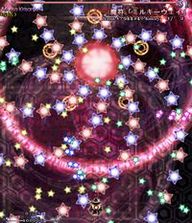
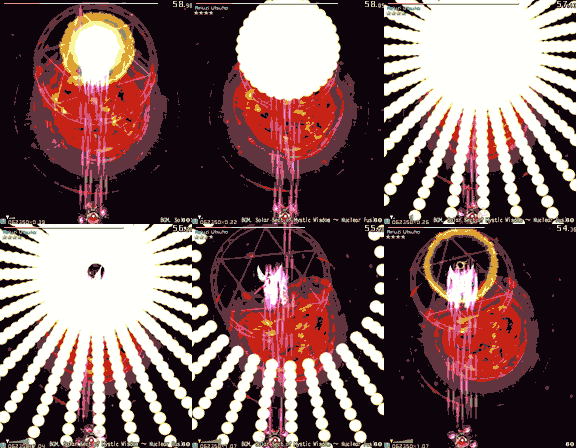
And her final card is the cleverest of all. Utsuho spawns bullets all over the screen. She then creates an artificial sun in the centre, which begins to gravitate all the bullets towards itself... along with your character!

And it only gets worse, as sunlight starts streaming outwards, and the pull of gravity intensifies... all while the sun gains mass and expands, restricting your movement even further.


Your enemy's power is so great that not only does it violate the physics of the world, but it even directly affects the way that you, the player, interact with it. This isn't suggested by some corny dialogue (the Touhou games do, admittedly, have plenty of corny dialogue), you aren't just told "Her power is too great! She's sucking in everything!" You are made to feel it in a visceral way. One might be reminded of the ending of Shadow of the Colossus, and that is also a fucking amazing game. Of course, games have interfered with a player's controls before, but Touhou's language is so refined, so limited, and so well established that it's a shock to have this happen, for the first time in eleven games. And it's perfectly placed: a fantastic climax to an intense final battle.

Comparing Utsuho to earlier final bosses, she just seems clearly more sophisticated from a design perspective. Remilia's okay. Yuyuko's patterns are absolutely gorgeous, extremely fun to play against, and she's actually one of my favourite bosses in the series for how well she brings together so many secondary elements like pacing and music. Kaguya's spell cards are ingeniously patterned around elements from the story of Kaguya-hime, on which she is based, and takes the game's Last Spell gimmick to a satisfying conclusion. Kanako uses a bunch of very clever and enjoyable patterns. But I don't think any of them approach the level of sophistication of Utsuho's attacks. None of them are so refined and thematically tight: none of them so completely describe the character's personality.

In a way, bullet pattern design like this is the most pure and perfect form of level design. Aesthetically, they're almost like abstract geometric patterns, which is the most basic kind of visual design possible. Functionally, however, they're able to be as complex and nuanced as a designer's imagination can fathom, as the rules of the game itself are so simple that there's almost no way to create something unintuitive or convoluted within it.

There's more to Touhou's clever game design, but I want to save those thoughts for another post.

(By the way, all the GIFs are from my own play on Normal mode.There are two more difficulty levels above this, Hard and Lunatic. And Touhou games are apparently not even considered hard by the shooting game community at large. On that note, if somehow a person who is actually familiar with games like Donpachi and Mushihimesama reads this post, and it turns out that those games do all this stuff but better, I apologise: I just haven't played them.)

Also I offer no apology for the tons of massive GIFs.

Mountain of Faith took me a very long time to beat, so I drew a picture to commemorate the fact. It's just fanart of the dodgy character designs and has nothing to do with what I've gone on about in this writing, but I tried to make it look nice, at least. I made it a bit of an exercise in colour and composition, though I still have lots to work on. Many sincerest thanks to Joe Sparrow (again) for giving me advice and generally being a bro.


More soon (actually never). Also I got sick of the X-Large image preview size being just slightly too wide for the default layout so I actually started dicking around with my blog design finally. I'll probably get rid of that cluttered sidebar at some point, as well as actually maybe concocting a background. It'll be a treat!